<center>
Wood Information-Yew
</center>
Yew's been an interesting plant to people for ages. Even when it's young, it looks ancient and old, and some claim that this makes it seem immortal. Familiar to many cultures, the origin of the name 'yew' may have even sprung from the word for Jehova, the Immortal. It shares such a similarity with ivy that their names are nearly identical in many languages.
(In Latin and in Portuguese, iva; in Old German, iua; in Welsh, yw; in Anglo-Saxon, eow; in Old English, iw, ew, ewe, eugh, and uhe; in French, if; in Swedish, id; and in modern German, eibe.)
It's a slow growing tree, common in many places of the world, especially peat bogs. Aside from wands, people have used it for cabinet work. Apparently it takes well to polishing.
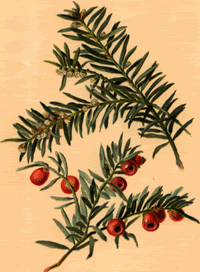
Yew is an evergreen tree, and pretty lethal to a lot of the creatures and foliage around it. Its shadow blocks the sun from smaller plants, and its seeds are poisonous, which has lead to the deaths of a lot of livestock and one or two humans.
It's because of it's innate connection with death that Yew was used in funerals. Even Shakespeare alluded to the custom of rubbing corpses with an infusion of Yew leaves, in order to preserve them. It was also used in the creation of bows, due to its flexible nature. Wand's probably going to be a whippy one, then...
The thing that really caught my eye is this, though:
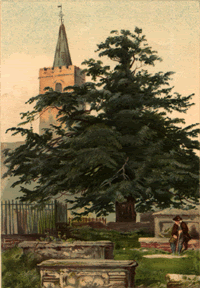
"The Yew is hot and dry, having such attraction that if planted near a place subject to poysonous vapours, its very branches will draw and imbibe them. For this reason it was planted in churchyards, and commonly on the west side, which was at one time considered full of putrefaction and gross oleaginous gasses exhaled from the graves by the setting sun. These gasses, or will-o'-the-wisps, divers have seen, and believed them dead bodies walking abroad. Wheresoever it grows it is both dangerous and deadly to man and beast; the very lying under its branches has been found hurtful, yet the growing of it in churchyard is useful."
That's from Robert Turner's "Botanalogia". Looks like Yew's sort of self-sacrificing, drawing the poisons of death into itself, a recognizable form that people know's dangerous, so that those poisons don't affect random passersby. Vision-seekers used to hang close to the Yew and inhale these vapors in order to get their visions, and people did all sorts of things with it to contact the underworld. That answers the question of why Wagner turned up when I brought it in, then...





 </center>








 <center>Jace in wolf form</center>










 </center>


